Your Online Quote Form Is Costing You a Full CSR and 20% of Your Margin
If your team is still doing 15–20 minute discovery calls and constantly “underestimating” first visits, the issue isn’t your CSRs. It’s a quote form built to spit out a number instead of understand a real home.
Your Online Quote Form Is Costing You a Full CSR and 20% of Your Margin
If your cleaning company is doing any meaningful volume of online quotes, your "simple" online quote form is probably costing you more than one full person in the office and a meaningful chunk of margin on the hard jobs.
Fifteen to twenty minute discovery calls just to clean up what the form should have figured out. At 200 new clients a month, that's roughly 60 to 80 CSR hours every month just cleaning up after a dumb form. First visits that run long because the quote didn't match the house. The constant back-and-forth on price — the "can you do any better," the customers who book and then add things on the day of, the customers who feel surprised by what wasn't included and tell their friends. Your trainer flagging the same scope-creep issue across half a dozen new clients in the same week.
None of that is a CSR problem. It's not a sales-training problem. It's not a "we need better discovery questions" problem.
It's a quote form problem — and almost every cleaning company in the country is running some version of the same broken setup without realizing it.
This piece is about what's actually going on under the hood. The quote form patterns the cleaning industry has converged on, what each one costs you, the one thing they all share, and the different kind of quote form — a problems-based quote form — that fixes the problem instead of routing around it.
If you've ever felt like every "improvement" you make to your quote process — better scripts, smarter CSRs, faster follow-up, a fancier form, an AI chatbot — produces the same headaches in a slightly different shape, this is why.
The quote form patterns cleaning companies actually run
Cleaning companies handle their online quote forms in about eight common ways. Each one works for somebody. Each one pays a specific cost. The cost is usually invisible from inside the pattern, because every operator's mental model of "what a quote form is supposed to look like" gets shaped by whatever pattern they're already running.
The instant pricing tool. Calculator or quote widget. Customer enters square footage and bed-bath count, maybe selects a frequency, and gets a number back immediately. They either book on that number or they don't. This works at volume — the customer gets immediacy, you skip the cost of a sales call on the bookings that come straight through, and the unit economics hold even at lower price points because there's no human conversion cost on top.
It also costs five things. It trains the customer to price-shop, because the first thing the form hands them is a number. It prices to an average — overpricing the easy jobs (where you lose to a cheaper quote) and underpricing the hard ones (where you eat the difference when the work runs long). It captures upsells weakly when at all — the calculator has a few standard add-ons as checkboxes but can't recognize the situations where a customer's actual needs map to a much bigger scope. It silently filters out customers who would have paid significantly more if the form had surfaced what they actually needed. And it gives your operations team almost nothing useful about the actual home, so the first visit becomes the real discovery process, with all the surprises that entails.
The lead capture form. Customer fills out a short form — name, address, contact info, maybe a few details — and someone calls them back. The number lives in the call, not on the page. This is the dominant pattern in cleaning above a certain price point. It controls the conversation, lets a human handle objections, and avoids training customers to comparison-shop on a public price.
It also has a labor problem nobody talks about honestly. The typical new-client booking call for a residential cleaning company runs fifteen to twenty minutes — qualifying, walking through pricing, handling "what's included," addressing the inevitable "can you go any lower," landing the booking. A company booking two hundred new clients a month is burning sixty to eighty CSR-hours on those calls. At fully loaded labor of $20-25 per hour, that's $1,200 to $2,000 of payroll every month sitting inside a process that mostly consists of reps doing work the form should have done. And that's before counting the leads who fill out the form on Sunday night, never get reached on Monday, and are already a customer of your competitor by Tuesday.
Tiered packages. Good / better / best. Three or four named tiers with checklists underneath each one. Customer picks a tier, sees the price for that tier at their home size, and books. Many of the most successful cleaning companies in the country run some version of this. It collapses pricing to a small table, the customer feels like they're choosing between defined options instead of negotiating, and your office spends less time explaining what's included.
The problem with tiers is that they're operator-defined, not situation-defined. You decided in advance what bundles of work would make sense for the average customer. Customers then have to pick the tier that's closest to their actual situation — which means your tiers either map cleanly onto what they need (lucky) or they don't (most of the time). The customer with hard water in their showers but otherwise fine doesn't fit "Deep Clean" even though Deep Clean is what would actually address the hard water. The customer with two large dogs and white carpet doesn't fit any tier specifically, because the tiers were built around standard rooms, not around pet hair on textiles. They pick the tier that sounds closest, get under-served, complain, and leave — and you never see the pattern because the tier name obscures the mismatch.
The other variations you've probably tried — range pricing ("homes like yours typically run $250-$400"), phone-only quoting where you refuse to give numbers without a call, value-content pages that gate the form behind a video and case studies, longer "tell us about your home" forms with twenty questions, custom-turnaround quotes you promise to deliver within twenty-four hours, conversational AI chatbots a vendor sold you last year — every one of them is a different surface on the same underlying setup. The chat is smoother. The form is longer. The price comes immediately, in a range, after a call, after a video, or out of an AI. The mechanics underneath are identical.
What every quote form pattern shares
Every pattern above is a different surface on the same underlying logic. The logic is: collect inputs, produce a number, route the customer into whatever closes the booking. Whether the price is delivered immediately, withheld for a call, ranged before a quote, layered behind content, structured into tiers, gated by a phone conversation, deferred to a custom turnaround, or extracted through a conversational AI — the underlying mechanics are the same. Inputs in. Number out. Booking flow.
That logic is the constraint. Every cost across every pattern is downstream of it. Customers self-disqualify because they're shown a number they can comparison-shop. You build expensive sales operations to convert the customers who didn't disqualify. Quotes mismatch reality because the inputs collected can't capture what's actually going on in the home. Reps spend fifteen to twenty minutes on calls doing work the form should have done. Tiers get picked wrong. The whole industry is paying these costs because nobody has questioned whether a quote form should be optimized to "produce a number" in the first place.
The alternative is to optimize the quote form for something else entirely.
The transactional layer and the problem layer
Every quote form above operates at what I'll call the transactional layer. The form asks for the inputs needed to produce a price. Square feet. Bed-bath count. Frequency. Add-ons. Maybe a preference checkbox or two. These are transactional inputs. They model the cleaning as a transaction the customer is shopping for, and the form's only job is to collect enough information to produce a number that customer can accept or reject.
A problems-based quote form operates at the problem layer. It doesn't ask the customer what service they want. It asks the customer what's actually going on in their home. Pet hair on furniture. Hard water staining the showers. Hardwood floors that have started looking dull. An infant about to start crawling. A previous cleaner who kept missing the same things. A house the customer feels embarrassed about. A spouse with severe allergies. A move-in next month and the previous tenants left it worse than expected. The dog who got into the trash last week.
These are not transactional inputs. These are situations the customer is living with daily. The customer already knows about all of them. They just don't normally have a structured place to say so on the way to booking a cleaning.
In plain English: most quote forms only know square feet and bed-bath count. They have no idea you've got two dogs, a baby, hard water, and a house you're embarrassed about. So your team has to find all of that out after the form — on the phone, while the customer is half-distracted — and then translate it into scope and price under time pressure. That's why you're stuck doing long discovery calls and guessing on scope. The form is doing none of the work it could be doing, because it's not built to ask the questions that actually matter for cleaning a real home. It's built to produce a number. You're paying humans to compensate for a form that was never designed to understand a real home.
Quick note: what you’re seeing here is a preview of how the problems‑based quote form works, not the full system. We’re deliberately only showing pieces of the flow and a couple of example screens. The live version has more logic, steps, and edge‑case handling than we’re publishing here.
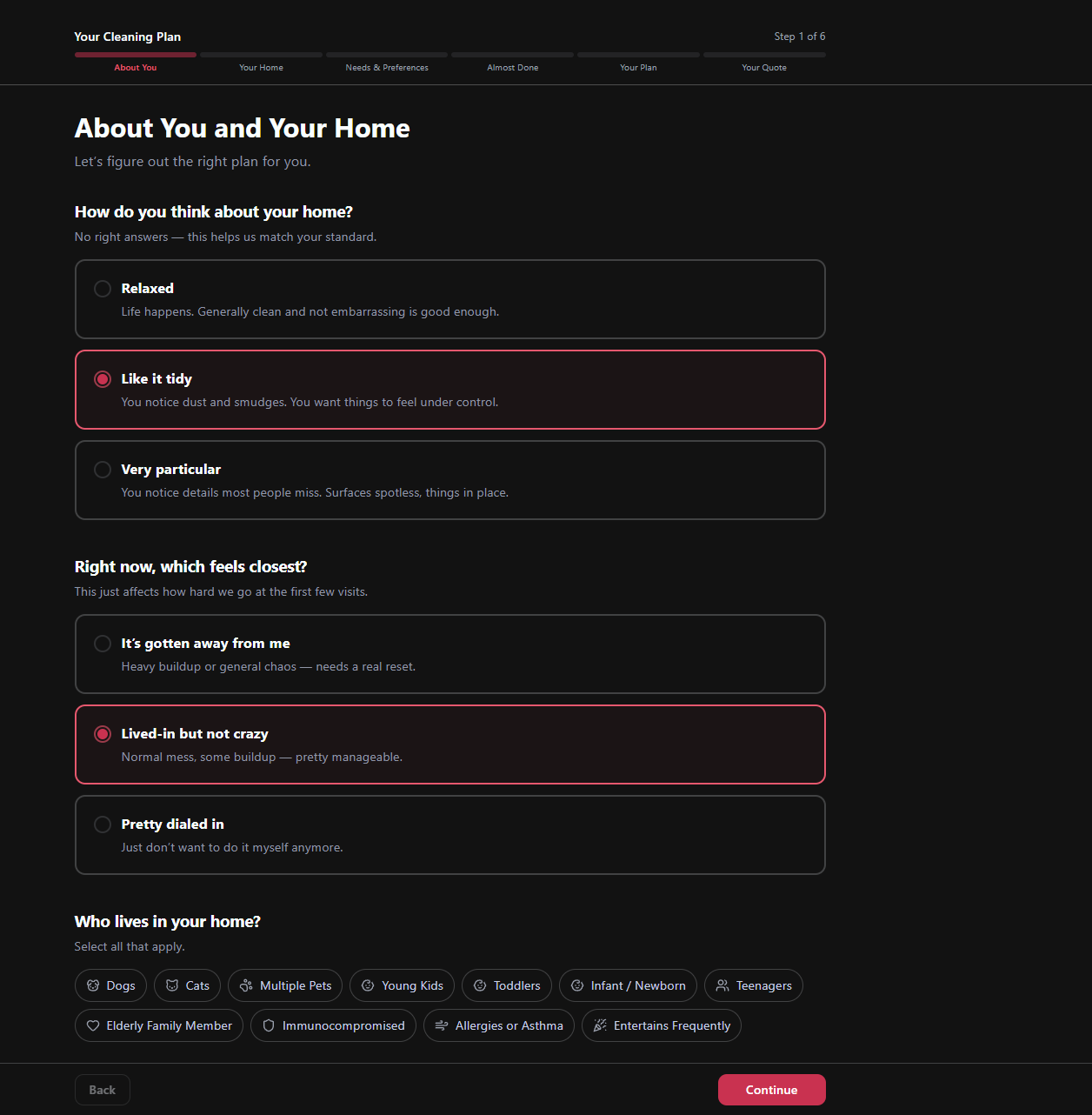
What happens when one customer reports four problems
Picture a recurring residential cleaning quote, but the form is built on the problem layer instead of the transactional layer. The customer is reporting situations as they go. Watch what happens to the resolved scope as the problems stack.
The customer reports first that there's an infant in the home. The form doesn't price this directly. It updates the home's profile — floor surfaces just became a priority because the floor is where the infant will be in three months, low-toxicity products just became required, the kitchen floor cleaning method just shifted from "wipe down" to a more thorough mop, the bathroom floor got the same upgrade, and a few specific items (under the high chair, the entry rugs, the area around the changing station) moved from optional to default. The price moved slightly. The customer didn't experience an upsell. They just told you about the infant.
The customer reports second that they have two dogs. The scope adjusts again. Pet hair removal moves from a default-light method to a more thorough one, requiring a different tool. The mop method shifts again — the floors now get the dog-mud-plus-baby-crawling profile, both of which push toward a sanitizing approach instead of a quick wet wipe. Certain fabric surfaces (couch cushions, dog beds, the area near the back door) move from optional to default. The price moved again. The customer didn't experience an upsell. They just told you about the dogs.
The customer reports third that the spouse has severe allergies. The scope adjusts again. Dusting frequency on horizontal surfaces moves up. Bedding rotation enters the recurring scope. The HVAC vent grilles get added — which most cleaning companies don't even include in a quote form and the customer wouldn't have known to ask about. The price moved again. The customer didn't experience an upsell. They reported the allergies.
The customer reports fourth that they've had a previous cleaner and were not happy because they kept missing the same details. The scope adjusts again — not by adding more this time, but by surfacing a section that asks the customer to describe what got missed, then routes those notes onto the trainer's QA checklist for the first visit so the cleaner who shows up actually pays attention to those specific items. The price didn't move on this one. The form just used the customer's complaint as direct input into the operations process.
By the time the customer is done reporting, the resolved checklist for their home is significantly different from a default checklist for a home that size, and the price is meaningfully higher. The customer never saw a tier. The customer never picked an add-on. The customer never had to translate "I think we need a deep clean?" into your vocabulary. They reported what was actually going on, and the form did your job of converting situations into scope and price.
That's the actual upsell mechanism. Quiet, automatic, no asker, no resistance. The customer doesn't feel sold to because nothing was offered to them. They told you about their home. The form responded.
This is why you keep getting "we underestimated" jobs and surprise scope on the first visit. Your current form has nowhere to put any of this information. So you either over-quote everyone (and lose work) or under-quote the hard ones (and eat it). On the hard homes, the mismatch between quote and reality is easily worth 10-20% of your margin every week it goes unfixed. The problems-based quote form fixes this by collecting the inputs that actually predict scope — not the inputs that produce an average price — and resolving the checklist from those inputs at booking time, before anyone walks in the door.
In our own cleaning company in Denver, our new-client phone calls used to average somewhere around eighteen minutes. After we moved to this form, the same calls run closer to five or six — and the office isn't doing the discovery work anymore, because the form already did it.
What the quote form is actually doing under the hood
A problems-based quote form is doing four department jobs at once, on the same surface. Most operators don't see it because the standard quote form patterns don't do any of these well, so the four jobs are spread across four departments inside the business.
Marketing job. The form meets the customer where their actual situation lives. The customer searches for "how to remove hard water stains from shower" and lands on a page that addresses exactly that problem and offers a service that addresses exactly that problem. The form on the page treats hard water as a real problem with real scope behind it, not as an afterthought add-on. The customer feels seen because they were able to articulate their actual situation in the actual language they use about it. The marketing job — "show the right customer that we're the right company for their specific problem" — is being done by the form's own vocabulary. You stop paying an agency to fight over generic head terms in saturated keyword markets and start attracting the customers whose specific situations your services were designed to address.
Sales job. The form does the discovery work. By the time the form is done, you know the home's situation in more structured detail than a fifteen-minute discovery call would have surfaced. Your CSR's role shifts from "qualify, build the quote, close" to "confirm the details, set expectations for the first visit, schedule." A booking call that used to run fifteen to twenty minutes runs four or five. The CSR is no longer doing sales — the form already did it. The CSR is doing confirmation and logistics.
Operations job. The form's output is the operations team's input. The resolved checklist for the first visit comes out of the form directly. The cleaner showing up gets a scope that was assembled from the customer's actual reported situations, not a generic tier the CSR picked because the customer "sounded like a deep clean." The trainer's QA notes from the form (the previous-cleaner complaints, the specific allergens, the rooms the customer flagged) flow directly into the cleaner's prep. The first visit is no longer a discovery exercise — the discovery happened on the form.
Pricing job. The price comes out of the resolved scope, not out of an averaged formula. The home with the infant, two dogs, allergies, and previous-cleaner concerns gets priced for what that home will actually take to clean to standard. The home with one cat and no other situations gets priced for what that home will actually take. You stop overpricing easy homes and underpricing hard ones, because the price stopped being a function of square feet times a multiplier and started being a function of the resolved checklist. The "we underestimated" jobs that were eating margin become rare events.
For a $1-3M cleaning company doing 150 to 300 new bookings a month, the shift from fifteen-to-twenty-minute discovery calls to four-to-five minute confirmations is roughly one full CSR's worth of time back every month. The labor recovery alone is real money. On top of that, you stop losing margin to scope creep because the quote finally matches the house, and you stop losing close rate to confused customers because the form did the translation work that customers couldn't do themselves. The margin recovery on the hard jobs and the close rate recovery on the muddled ones are both bigger than the labor recovery, even though the labor recovery is what shows up first.
The form is replacing four departments' worth of operating cost with one surface that does the work upstream.
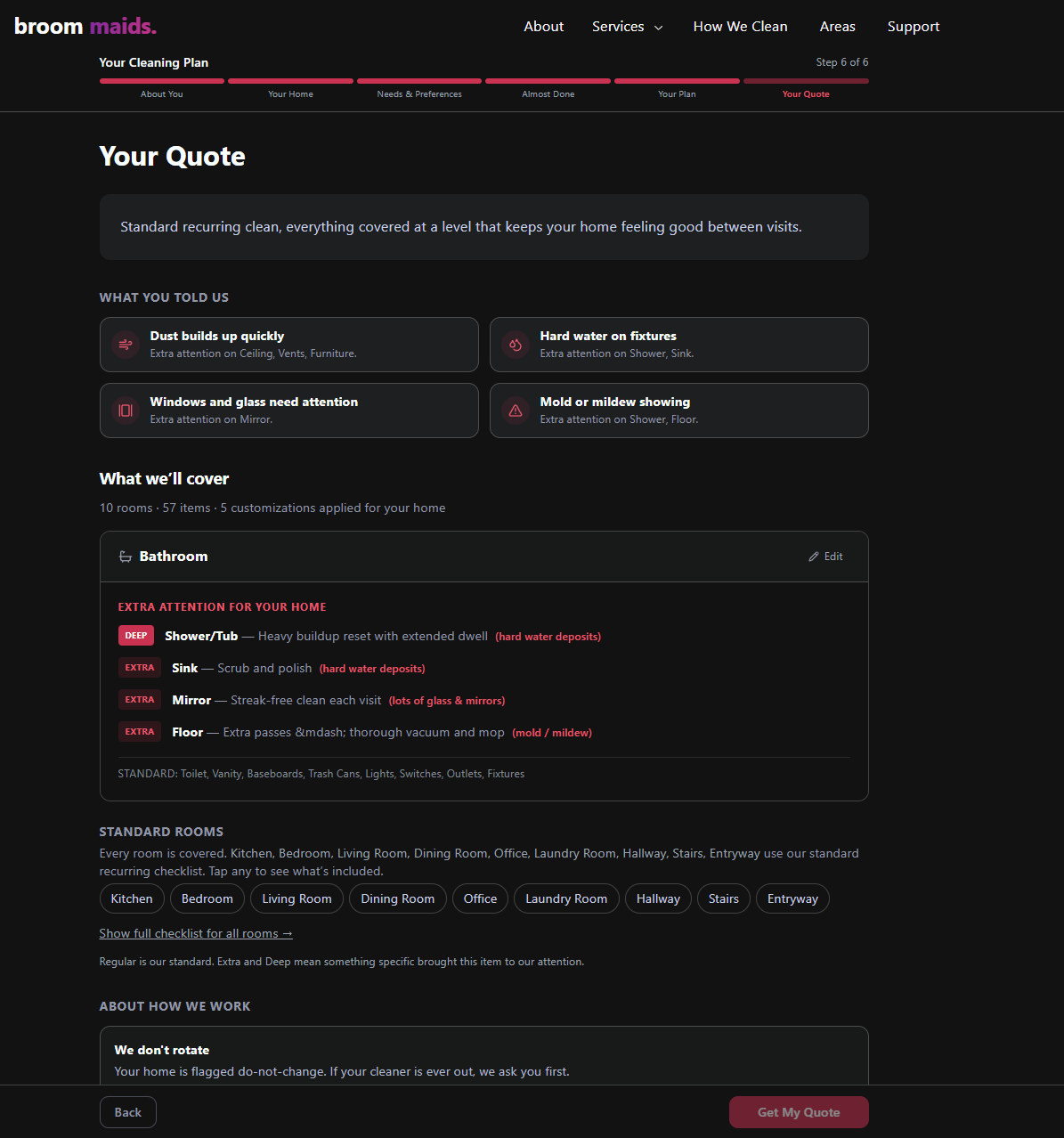
What this actually looks like on your site
If you're nervous about "a long form scaring people off," here's how we actually run this in our own cleaning company. The problems-based quote form doesn't replace basic lead capture. It sits after it.
The page does three things, in order:
- Simple lead capture pops first. Name, email, phone, city or ZIP. If the customer does nothing else after that, you still have the lead.
- Then the problems-based quote form. Anyone who wants a fast, accurate quote clicks through and answers the situational questions at their own pace.
- If they bail, your office runs the same flow live. When a lead only fills out the basics and stops, your CSRs pull up the exact same problems-based flow and use it as their call script. No lead is lost. The form either closes the loop on its own, or the office finishes it with the customer on the phone.
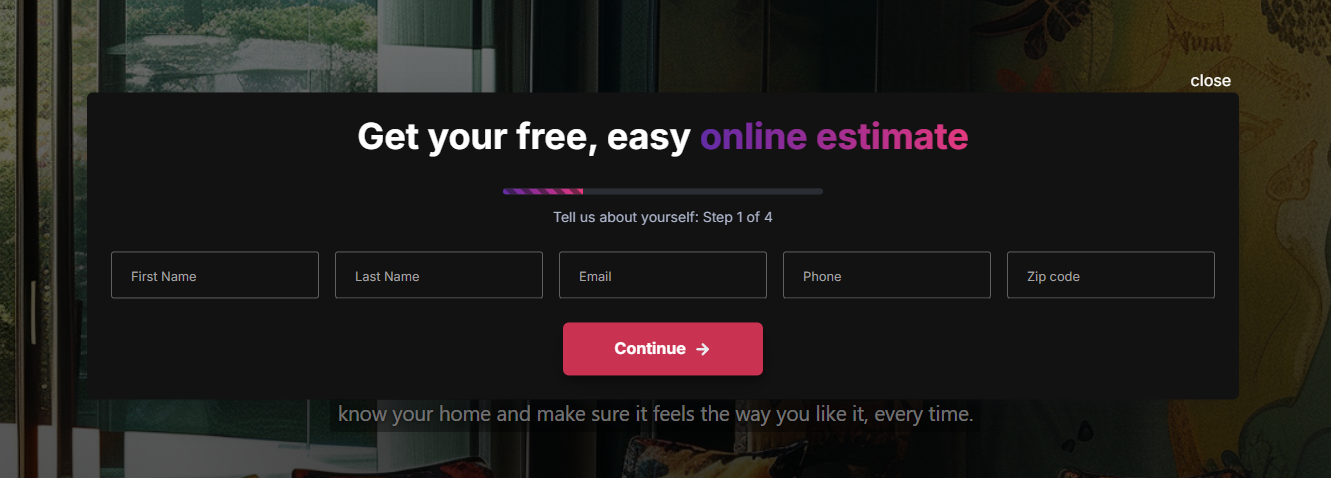
You're not gambling your funnel on "will people finish a longer form." You get the safety net of a simple popup lead capture and the power of a problems-based quote form your team can run live as a script for anyone who doesn't finish it. Your CSR doesn't have to invent a new script — the form is the script.
The problems list underneath the form
The problems-based quote form requires something the standard patterns don't: a problems list. Every problem the customer can report needs to have a defined method for addressing it, a default scope it applies to, the items it modifies on the resulting checklist, the products and tools required to handle it, the time it adds to the visit, and the price impact that flows from all of that.
That problems list is a substantial piece of work to build. The first instinct of most operators looking at it is "great, more work — and I don't have time for that." The second observation, after the list exists, is that it turns out to be the most leveraged asset in the entire business.
It's content infrastructure. Every problem on the list has a definition, a context, methods, an outcome description. Your website can generate problem-specific landing pages from the list itself. The "how to remove hard water stains" page is a render of the hard-water-stain entry. The "what causes pet hair buildup on furniture" page is a render of the pet-hair-on-textiles entry. You stop paying an agency to write fresh copy for every page and start generating pages from operational reality — pages that are good because they're written from actual operational knowledge, not from SEO research.
It's SEO infrastructure. Sixty-plus problem entries become sixty-plus problem-specific landing pages. Each one ranks for specific long-tail searches your competitors aren't targeting, because the competitors don't have the list and can't write the page from a position of actual operational knowledge. Top-of-funnel CAC starts dropping because organic problem-specific search traffic compounds month over month while your paid traffic stays flat at whatever the auction price is that week.
It's training infrastructure. Your trainer onboarding a new cleaner pulls up the entry for any specific problem they want to cover that day — method, products, time expectation, QA criteria. The trainer stops writing materials from scratch and starts referencing the same list operations is using to scope the work.
It's QA infrastructure. The scorecard the trainer fills out after a quality check references the same outcome definitions the form used to scope the visit. The cleaner who missed a specific item missed it against a specific definition of what the item required. The complaint that comes in from a customer is being checked against what the list said the scope included.
Most operators are paying agencies to write SEO copy, paying trainers to build materials from scratch, paying QA to write scorecards that don't reference operational reality, and paying marketing consultants to segment customers by guesswork. Once the problems list exists, those costs collapse — and the resulting content is meaningfully better because it's generated from operational truth instead of agency interpretation.
Why "we'll just add AI to our form" doesn't fix this
Every operator looking at the patterns above and feeling the pain is being told by SaaS vendors right now that the answer is to add AI to the existing quote form. A chatbot. An LLM that asks better questions. A natural-conversation interface that captures the nuance a static form misses.
The pitch is appealing because it requires no real change. The form stays. The tiers stay. The pricing engine stays. The AI sits on top and makes the surface feel smoother. The vendor charges a monthly fee. You keep doing what you were doing, just with a chattier quote experience.
This doesn't fix anything, because the problem isn't the surface. It's the questions the form is built to ask in the first place. AI doesn't fix asking the wrong questions. It just asks them more pleasantly.
If you want this kind of quote form on your site
We built the problems-based quote form for our own cleaning company. It's running our new-client funnel now — replacing what used to be a standard lead-capture form on top of a tier-based pricing tool. The change in our operations is significant enough that we're rolling the same form out to a small group of other cleaning companies as a beta.
Who this is for
- Established cleaning companies (typically $500K to $5M in annual revenue)
- You're already getting online leads, already doing phone quotes, and already feeling the cost of long discovery calls and surprise jobs
- Your office is at or near capacity on inbound calls and quotes
- You want to grow without doubling your CSR headcount to get there
What we do
- Sit down with you and map your actual services and common home situations into a problems list built around your business, not a generic template
- Build and install the problems-based quote form on your existing website
- Connect the form to whatever tools you already use (MaidCentral, Housecall Pro, ZenMaid, Jobber, etc.) so the bookings flow into your existing process without disruption
- Tune the form against your real customer traffic until your new-client booking calls are running as four-to-five minute confirmations instead of fifteen-to-twenty minute interrogations
What this changes in your day
- New-client calls drop from 15-20 minute discovery to 4-6 minute confirmation
- "We underestimated" first visits become rare outliers instead of weekly events
- Hard homes get priced and scoped like hard homes, so you stop giving away work for free
- Your cleaners walk in knowing what they're walking into, which means fewer callbacks and complaint credits
Beta terms
We're taking on 5 to 10 cleaning companies in this beta at roughly half of what this implementation will cost once the software is public. In exchange, your feedback shapes the productized version. Beta operators get permanent access to the implementation we build for you, ongoing support as we improve the list and the form, and pricing that won't be available again once we launch publicly.
If your new-client booking calls aren't at least 30% shorter within 60 days of go-live, we keep working on it until they are. If we can't get you there, you don't pay our implementation fee.
If you'd like to be one of the beta operators
Drop your details below and tell us a bit about your company. We'll get back to you within a couple of business days. If we're a fit, we'll book a call to walk through your current quote process and what it would look like to rebuild it on this form.